
Articles Posted in Parental Alienation

Published on:

For 15 years I have written a nationally recognized Family Law blog at www.illinoisdivorcelawyerblog.com, focusing on complex subjects including Parental Alienation in Illinois child custody cases. Drawing from these blog posts and my research as a longstanding member of Parental Alienation Study Group , this concise book is now available on Amazon. My hope in working on this book is that this book will be a helpful resource for all family law professionals in understanding the phenomenon of child estrangement and alienation in family systems and family law cases.
“I take parental alienation seriously as a real and damaging phenomenon. I have watched it destroy relationships between loving parents and their children, and I have watched it inflict lasting harm on the children themselves.”
Amazon Link:
Published on:

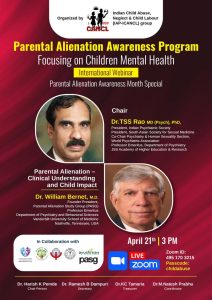
Please see the flyer below announcing an upcoming virtual conference that takes place in India and of which PASG is a sponsor. Anyone in India and the rest of Asia as well as Australia may wish to attend. If you are a very early riser, members in the U.S. can choose to join in.

Zoom login details for the session that includes Dr. William Bernet, the founder and first president of PASG, are listed below.

PASG-Talk-42126-212x300

Published on:

Parental alienation is often described in terms of three levels or degrees, which reflect the severity of the alienating behaviors and their impact on the child’s relationship with the targeted parent. These levels were notably outlined by  experts like Dr. Amy J. L. Baker. Here’s a breakdown:
  1. Mild Parental Alienation
    • Description: The child exhibits mild resistance or reluctance to spend time with the targeted parent but still maintains a relationship. The alienating parent may subtly undermine the other parent through occasional negative comments, scheduling conflicts, or mild interference.
Published on:

Michael Roe has for many years focused a significant part of his practice on Child Custody issues, including Parental Alienation cases. Few lawyers nationally have the background, experience, and dedication to this critical issue in Family Law.  As a long term member of PASG, our firm already looks forward to the PASG meeting this year, with details below.
One Definition of Parental Alienation:
Parental alienation refers to a situation in which one parent intentionally or unintentionally manipulates a child to reject, fear, or distance themselves from the other parent without legitimate justification. This behavior often involves actions such as badmouthing the other parent, limiting contact, making false allegations, or coaching the child to adopt negative views about the targeted parent. In Illinois, parental alienation is considered a form of emotional abuse because it harms the child’s psychological well-being and undermines the child’s relationship with both parents. Illinois courts prioritize the best interests of the child in custody and parenting time decisions, and evidence of parental alienation can significantly influence these outcomes.
Published on:

It’s always interesting to read the famous Illinois Supreme Court case of In re Marriage of Bates, 212 Ill. 2d 489. As a younger lawyer I was an attorney on this case, and later was subpoenaed by the trial counsel to testify in the case as an expert knowledgeable in the field of Parental Alienation studies. This case is a landmark case in the area of Parental Alienation, as Illinois recognized Parental Alienation as a factor in a child custody decision.

—-Comments from the Court—-

“E, as proponent of the PAS testimony, proffered three expert witnesses and 136 articles from peer-reviewed publications as exhibits.

Published on:

Signs of parental alienation include: badmouthing the other parent, limiting contact with the alienated parent, interfering with communication, forcing the child to choose sides, creating a perception of danger from the alienated parent, asking the child to keep secrets, referring to the alienated parent by their first name, withholding important information, changing the child’s name to distance them from the alienated parent, cultivating dependency in the child, and the child exhibiting a lack of ambivalence or guilt towards the alienated parent, often claiming their negative feelings are their own choice (“independent thinker phenomenon”) while supporting the alienating parent excessively. 

Key points to remember:
  • Negative campaign:
Published on:

PSYFORIS-Logo-PASG-300x168

Parental Alienation Study Group, Inc (PASG), is a nonprofit international organization of mental health professionals, legal professionals, targeted parents and grandparents, and child and family advocates who are interested in the study of parental alienation. 

Contact Information